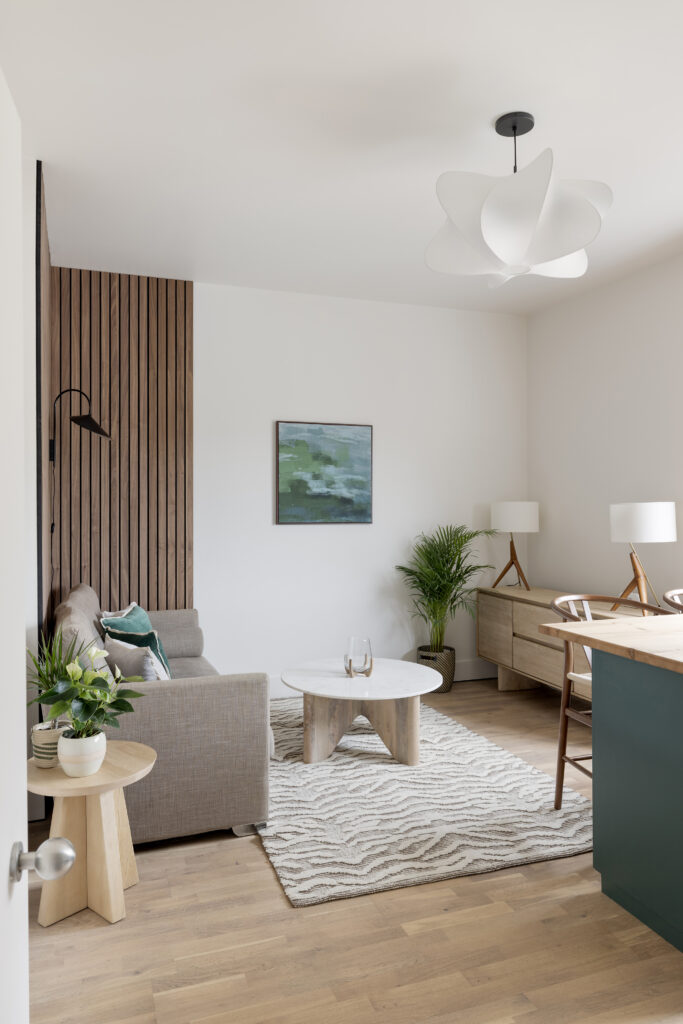
Thought Piece: Sustainability for the Soul.
Why housing policy must measure noise, light and air – not just carbon.
London, UK, Jan 2026 – By Alex Uregian, MD of City Sanctuary (As published in the Estates Gazette January 2026)

Policy versus lived experience
One of the stated objectives of the Government’s landmark £39bn Social and Affordable Housing Programme and the recently Announced Warm Homes Programme is to improve the quality of our existing housing stock. While this update includes important improvements, not least with respect to damp and mould, ask any housing officer and they will tell you that tenant complaints in their inbox go well beyond these issues. One officer recently told me that as much as half of tenant complaints are about noise. Half.
This disconnect between policy and lived experience was further illustrated by another recent conversation regarding a London development where the local planning authority insisted on large open balconies. The architects duly complied but the balconies were rarely used by the residents because they were too windy and noisy. Valuable space and resources were effectively wasted, when they could have been invested in features residents would genuinely value and benefit from.
Homes Can Harm, But They Can Also Heal
From our experience at City Sanctuary, the company I founded, one aspect that residents genuinely value and which has benefits for society at large are upgrades with demonstrable effects on health and well-being. In light of NHS England estimates that poor housing costs the national health service £1.4bn annually[1], it’s understandable that policy-makers seek to ensure social and affordable housing doesn’t do harm. However, we can be much more ambitious: Numerous studies show that small adjustments in homes, notably to light, air quality and noise, amongst others, can improve residents’ health.
Take noise that the housing officer mentioned to me. Even everyday exposure above 40–50 dB(A) disrupts sleep, attention and memory. Long-term levels above 55 dB(A) raise cardiovascular risks. Children are most vulnerable, but everyone feels the stress. Effective soundproofing through acoustic insulation does not just reduce neighbour noise. It creates calmer, healthier homes, and the added insulation makes buildings more sustainable too.
On light, one of our residents told us:
“The light shifts through the day, brighter and more energising in the morning, warmer and calmer in the evening thanks to the programmable light settings. It helps my mind wake up and relax more comfortably. The low-level night lighting lets me move around without waking myself up whilst the automated blackout blinds help me finally sleep through the night for the first time in years.”
Equally when it comes to air, I know that the purifiers and dehumidifiers ensure nothing is harmful. Living in a large bustling city like London means it’s even more important to come home to a calm environment, tailored to supporting my health and that’s exactly what City Sanctuary does.”
Noise, light and air are just three components of home features that can actively promote occupants’ health and their wellbeing if that is a primary consideration. IWBI:WELL – International WELL Building Institute, is one of the leading global accreditation for health and wellbeing in the built environment, and has codified all relevant features in their new Residential Standard aimed at supporting health.
The Business Case
A common misconception is that health-first home design is a luxury with prohibitive cost or that residents aren’t willing to pay for the benefits. On the contrary, City Sanctuary has just delivered the UK’s first WELL-certified residential retrofit in Whitechapel to a mid-market spec which added less than 10% to the total renovation costs. Tenants subsequently paid 20% higher rent compared to equivalent renovated units not spec’d to the WELL standard.
In affordable housing, the payback cannot come through rental premiums but could be realised through lower void periods/churn, improved resident satisfaction and fewer complaints, all of which are the pathway to long-term operational efficiency.
A Policy Realignment Is Overdue
The science and business cases have already convinced countries and councils to move beyond energy efficiency and to take a holistic approach to resident wellbeing when it comes to housing. Denmark, Finland and Sweden build health into housing design from day one and consistently rank among the world’s healthiest communities. Wales has passed a Well-being of Future Generations (Wales) Act 2015.
In England, councils such as Ealing have already adopted holistic ‘health and wellbeing’ frameworks in their housing strategy, placing ‘healthy, safe and sustainable’ homes at the heart of planning and community wellbeing. This signals that local authorities do not have to wait for national regulation to start acting for residents’ benefit.
The scale of the challenge, and opportunity is striking. As of 2023, only 48% of English homes have achieved EPC C or better, meaning more than half remain below this benchmark. With billions slated for energy upgrades, we must ask: are we improving ratings or genuinely improving lives? We must do both, otherwise we risk building the next generation of windy balconies with costly features that residents don’t use or value.
SMEs: An army for Healthy Homes
Small and medium-sized developers are uniquely placed to lead this shift. Nimble, close to their communities, and able to test and adapt faster than larger players, SMEs can reach where the “big ships” of volume housebuilders often cannot. A coalition of SME developers, progressive housing associations and forward-thinking private landlords could start with 100 pilot retrofits across different regions and stock types, measuring complaints, satisfaction and health outcomes, and proving the return on investment. The model we’ve piloted in Whitechapel is replicable and scalable, but it requires partnership: housing associations with stock to upgrade, private landlords seeking differentiation, and councils willing to champion evidence-based innovation.
Healthy homes should not be the preserve of the luxury market. We have the evidence, the tools and the blueprint.
For housing providers interested in exploring joint ventures or pilot partnerships to scale health-first design, the door is open. The question is: who will answer the call?
For enquiries: media@citysanctuary.com